
AIC2030 Geoeconomics Review · November 2026
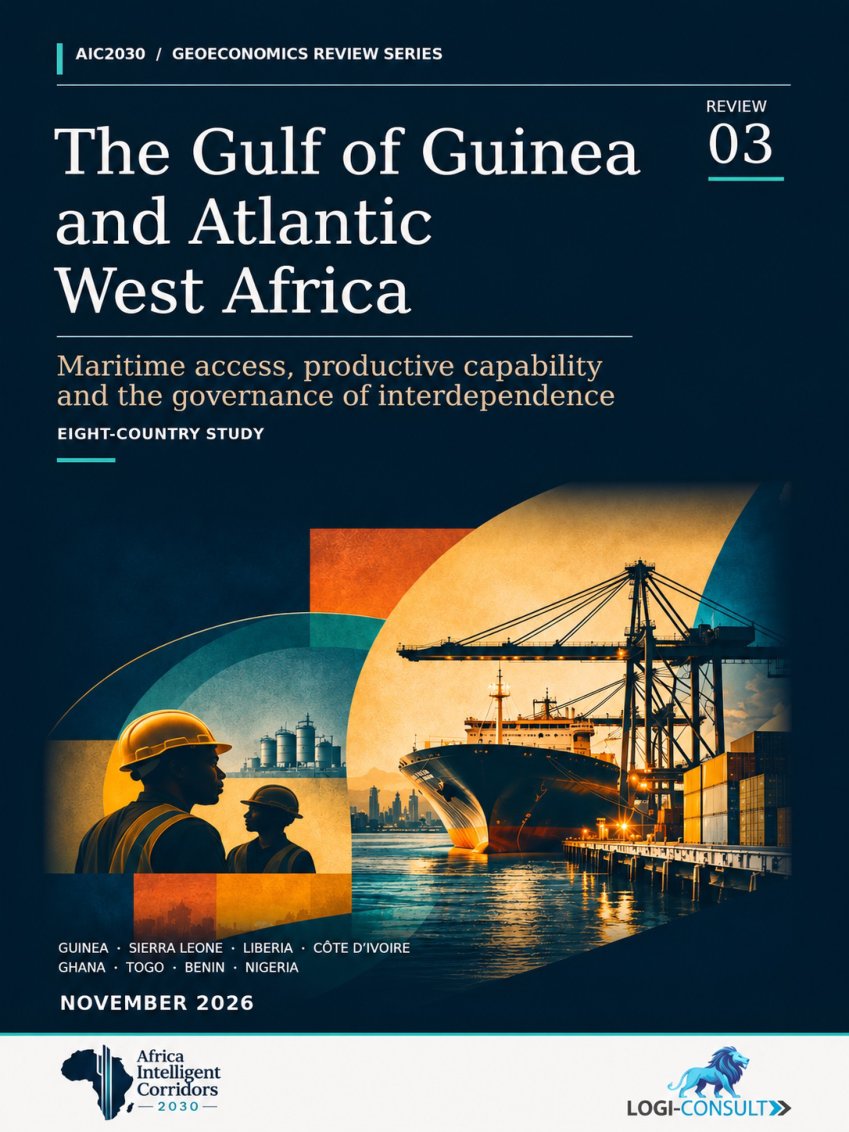
The Gulf of Guinea and
Atlantic West Africa
Maritime access, productive capability and the governance of interdependence
Africa rising by itself.
Download the reviewEnglish · 79 pages · PDF · 3.49 MB
Access with your work email.
About the review
Make regional trade work. Then negotiate from strength.
Africa’s Atlantic economies can strengthen their bargaining position by making regional trade work in practice. This review starts with the services African institutions can operate together: clearance, settlement, essential supply and transit continuity. Those services reveal demand and the terms on which investment can widen economic choice.
Guinea, Sierra Leone, Liberia, Côte d’Ivoire, Ghana, Togo, Benin and Nigeria are read as eight differentiated country strategies, with an eight-country decision matrix naming each economy’s strategic choice, first move and proposed lead.
The review distinguishes announcements, legal agreements, financing, commissioning, operating service and verified outcomes. Judgement boxes state each conclusion, its confidence, the implications for the eight economies and a first action.
Clear and pay for trade
The first priority is clearing and settling trade on existing corridors: pilot two crossings and two settlement pairs, and test AfCFTA preferences on real orders and paid invoices.
Secure supply and continuity
Essential supplies, power and coastal–Sahel transit continuity are treated as shared services, with seasonal baselines, delivery-backed electricity exchange and a named-contact contingency protocol.
Negotiate external terms
Open supplier markets and tighten capital terms: improve existing services first, then scale capital commitments against observed demand, access and public obligations.
Inside the publication
The review, chapter by chapter.
Eleven chapters move from scope and historical foundations through resources, production, food and supply security to gateways, security, integration, capital and the architecture of economic sovereignty.
Also includes an executive assessment, a reader’s guide to evidence and confidence, eight country profiles, methods and instruments, and references.
- 01Scope and Stancep. 5
- 02Foundations: History, People and Institutionsp. 9
- 03Resources, Energy and Waterp. 15
- 04Production, Cities and Marketsp. 20
- 05Food, Fisheries and Agro-Industryp. 27
- 06The Four Fs: Supply Securityp. 31
- 07Gateways and Corridorsp. 35
- 08Security, Continuity and Coastal–Sahel Tradep. 42
- 09African Cooperation and Integrationp. 48
- 10Capital and Negotiating External Termsp. 51
- 11Scenarios and the Architecture of Economic Sovereigntyp. 55
Read the complete review
The Gulf of Guinea and Atlantic West Africa
November 2026 publication edition · English · 79 pages