
AIC2030 Geoeconomics Review · October 2026
The Sahel in a
Reconfiguring Africa
Geopolitical power, economic interdependence and strategic choice
More power over terms. Uneven power over outcomes.
Download the reviewEnglish · 36 pages · PDF · 3.82 MB
Access with your work email.
About the review
Regional power is relational. National choices cross borders.
The Sahel is a geography of production, exchange and strategic access. Political borders, trading networks and resource systems overlap without creating a single economic or institutional order. This review asks how changing political and economic relationships are reshaping power, interdependence, productive capabilities and strategic choice across the region.
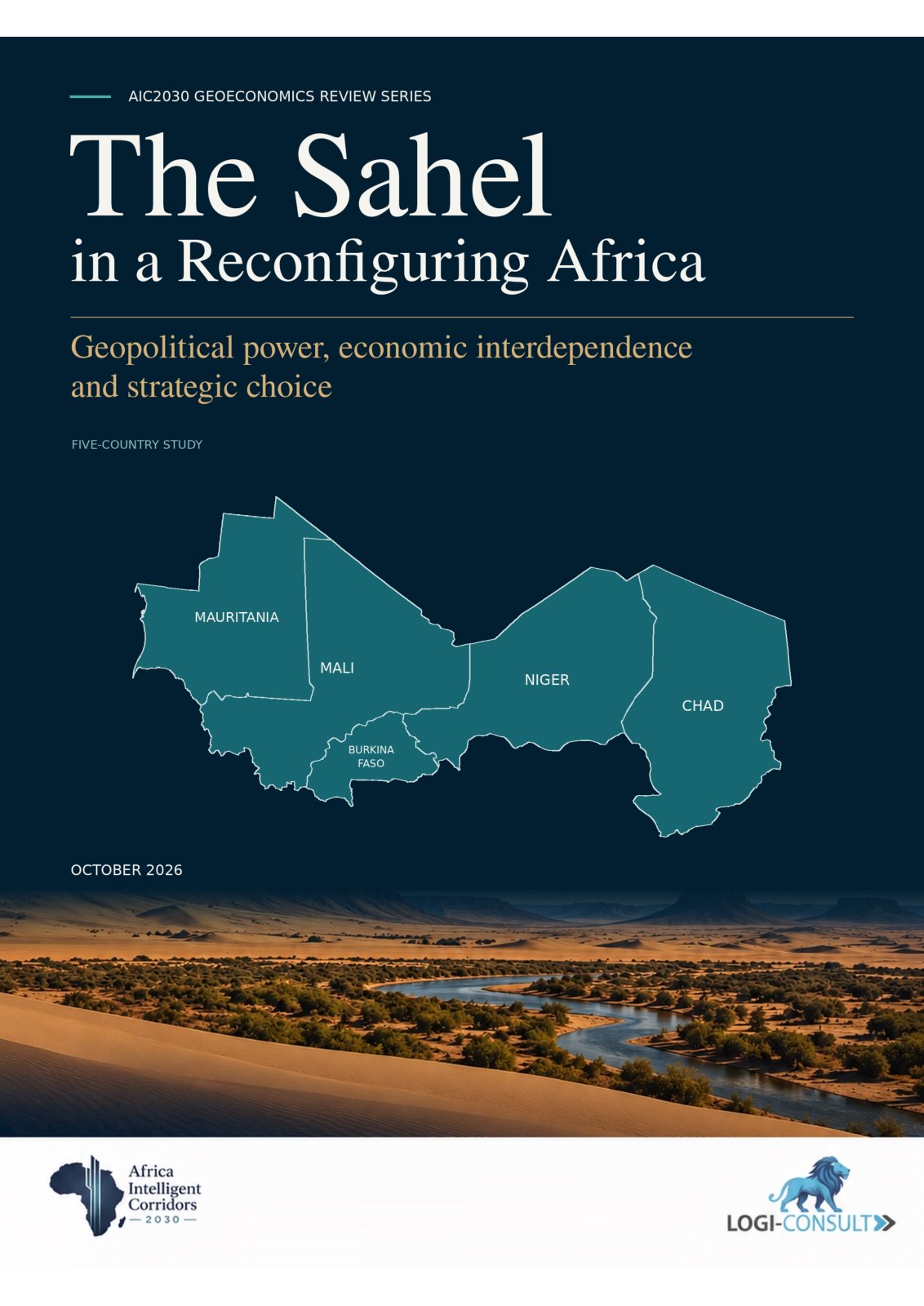
Mali, Burkina Faso, Niger, Chad and Mauritania form a purposive comparison of inland and Atlantic access, institutions and resource-linked relationships. Dated institutional records, statistics, project disclosures and company accounts are compared to map economic chains and reconstruct selected event sequences.
The review distinguishes documented mechanisms from interpretation, assessment and conditional scenarios. Its regional test is practical: identify the controlling interface, credible substitutes, switching costs and who retains value.
Resource authority resets terms
Ownership, fiscal rules and state participation are being renegotiated across the region. Export, operation, finance and sales remain separate interfaces, so new authority over terms does not mean control of whole chains.
Gateways shape inland bargaining
Coastal gateways, transit arrangements and dedicated export chains condition usable sovereignty. Additional gateways widen choice only when transport, border services, finance and security make them commercially usable.
Diversification is not transformation
New partners, legal rights, commissioned capacity and corridor approvals may change bargaining positions. Development gains still have to be shown through dependable service, productive linkages and retained value.
Inside the publication
The review, chapter by chapter.
Seven chapters move from the region's economic geography through institutions, dependencies, strategic resources, energy and capital to productive integration and four conditional pathways to 2030.
Also includes the research approach, executive geoeconomic findings, a section on power, resource control and social exposure, a regional conclusion and references.
- 01The Region in Contextp. 5
- 02Economic Power and Institutionsp. 8
- 03Economic Security and Dependenciesp. 11
- 04Strategic Resources and Valuep. 14
- 05Energy and Capitalp. 19
- 06Productive Capabilities and Integrationp. 22
- 07Strategic Interpretation and Scenariosp. 32
Read the complete review
The Sahel in a Reconfiguring Africa
October 2026 publication edition · English · 36 pages